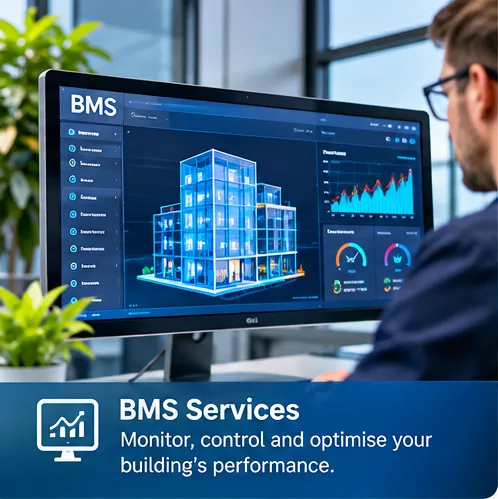
A building management system (BMS) is the network of sensors, controllers and software that monitors and automates a building's mechanical and electrical services. It switches plant on and off, holds temperatures at setpoint, raises alarms and records trend data. When a BMS is working well it is the single most useful diagnostic tool a facilities team has; when it is poorly configured it can waste energy and hide faults.
What does a building management system actually do?
A BMS has four core jobs:
- Control: running time schedules, holding temperatures and pressures at setpoint, and sequencing plant such as boilers, chillers and pumps.
- Protection: interlocks and safety logic, for example stopping an AHU if the frost thermostat trips or a fire alarm signal is received.
- Monitoring and alarms: telling the operator when something has failed or drifted out of range.
- Data: recording trend logs and meter readings that show how the building behaves over time.
How is a BMS put together?
| Layer | Components | Typical faults |
|---|---|---|
| Field devices | Temperature, humidity, pressure and CO2 sensors; valve and damper actuators; current switches | Drift, failure, poor location, seized actuators |
| Controllers | Outstations, plant controllers, room controllers | Lost programmes, failed I/O cards, power supply faults |
| Network | BACnet, Modbus or proprietary networks, IP backbone | Communication loss, addressing conflicts, cyber security gaps |
| Supervisor | Head-end software and graphics | Out-of-date graphics, alarm floods, unsupported versions |
A useful mental model: sensors are the eyes, actuators are the hands, controllers are the brain, and the supervisor is the window you look through. A fault visible on the supervisor might originate in any layer.
What are the most common BMS problems?
- Sensor faults: a single failed return air or outside air sensor can make whole systems behave wrongly. See BMS temperature sensor faults.
- Alarm overload: hundreds of nuisance alarms bury the genuinely important ones. See BMS alarm management.
- Hand overrides left in place: plant forced on or off months ago and forgotten.
- Schedules that no longer match occupancy: particularly after hybrid working changed how buildings are used.
- Control loops fighting: heating and cooling valves both open, or poorly tuned loops causing hunting.
- Obsolete hardware or software: spares become hard to find and integration becomes difficult.
How should you use BMS trend logs?
Trend logs turn complaints into evidence. When a zone is reported as cold, plot the room temperature, setpoint, heating valve position and LTHW flow temperature over the same period. Patterns typically show whether the cause is supply (no hot water), control (valve not opening) or demand (setpoint wrong). Make sure critical points are trended at sensible intervals and that history is retained long enough to compare seasons.
Safety: BMS panels contain mains voltages and control plant that may start automatically. Only competent controls engineers should open panels, change control logic, or override safety interlocks. Never disable frost, fire or high-limit protection to clear a nuisance alarm.
BMS optimisation: where are the quick wins?
- Align time schedules with real occupancy and holiday calendars
- Introduce optimum start/stop so plant runs only as long as needed
- Widen deadbands between heating and cooling setpoints
- Apply weather compensation to heating flow temperatures
- Remove long-standing overrides and document any that must stay
- Review alarm priorities so critical events are seen immediately
When should you involve a controls specialist?
Bring in a controls engineer when you need control logic changed, outstations replaced, networks fault-found, or the system integrated with new plant. Ask for an up-to-date points list, control strategy description and as-installed graphics as part of any work. These documents are essential for future maintenance and for any change of contractor. Flair Facilities covers the full lifecycle, from BMS design and build to repair.
flairfacilities.co.uk
More BMS expertise from Flair Facilities
- Service Siemens BMS Engineer London Fault diagnosis, maintenance and technical support for Siemens building management systems. Read on Flair Facilities
- Guide What is BMS energy drift? How sensor drift and poor calibration quietly waste HVAC energy, and how to prevent it. Read on Flair Facilities
- Service BMS repair, design & build BMS design, build and repair that brings boilers, chillers and HVAC under one system. Read on Flair Facilities
- Service BMS integration & smart building Open-protocol integration that connects plant, lighting and metering into one smart building. Read on Flair Facilities
Frequently asked questions
What is the difference between a BMS and a BEMS?
The terms are often used interchangeably. BEMS (building energy management system) emphasises energy monitoring and optimisation, while BMS is the broader term for controlling and monitoring building services. In practice most modern systems do both.
What are BMS outstations?
Outstations are the programmable controllers, usually located in plant rooms or control panels, that run the control logic for connected equipment. They read sensor inputs, drive outputs such as valves and pumps, and communicate with the supervisor software.
What protocols do commercial BMS use?
BACnet and Modbus are widely used open protocols, alongside LonWorks and various manufacturer-specific protocols. Open protocols make it easier to integrate equipment from different suppliers and to change maintenance contractor.
How do I know if a BMS sensor is reading incorrectly?
Compare it with a calibrated hand-held instrument, look for flat-lined or erratic values in trend logs, and check it against neighbouring sensors. Our guide to BMS temperature sensor faults covers this step by step.
UK technical references
Primary sources and industry guidance relevant to this topic. Always check you are working to the current edition.
- CIBSE Guide H: Building control systems (via the CIBSE knowledge portal) — Chartered Institution of Building Services Engineers
- Building Controls Industry Association — BCIA
- Approved Document L: Conservation of fuel and power — GOV.UK
- BACnet International — BACnet International
This guide is general technical information for commercial property teams in the UK. It does not replace a site-specific assessment. Gas work must be carried out by a Gas Safe registered engineer, and work on electrical, pressurised or combustion equipment by competent, appropriately qualified people.