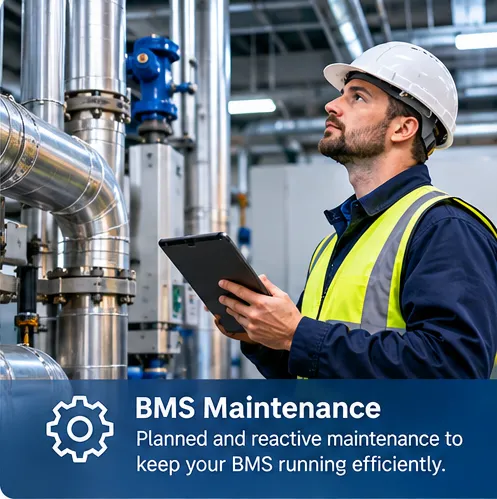
A commercial plant room houses the central equipment that heats, cools and supplies water to a building: boilers or heat pumps, circulation pumps, low loss headers or heat exchangers, pressurisation units and expansion vessels, calorifiers, booster sets, water treatment and controls. Because these items are hydraulically and electrically linked, a fault in one often appears as an alarm on another, so inspections should follow the flow of water and energy through the room.
What equipment is found in a commercial plant room?
| Equipment | Function | Key things to watch |
|---|---|---|
| Boilers or heat pumps | Generate heat | Alarms, lockouts, combustion air, condensate |
| Primary and secondary pumps | Circulate water | Noise, vibration, duty/standby changeover, seal leaks |
| Low loss header or plate heat exchanger | Separate primary and secondary circuits | Temperature differentials, air, dirt |
| Pressurisation unit and expansion vessels | Maintain system pressure and absorb expansion | Pressure, pump run frequency, vessel pre-charge |
| Calorifiers or hot water cylinders | Produce stored domestic hot water | Storage temperature, Legionella control, safety valves |
| Booster sets and cold water tanks | Supply cold water at pressure | Pressure, pump cycling, tank hygiene |
| Water treatment and dirt separators | Protect system water quality | Dosing levels, sample results, blowdown |
| Control panels and BMS outstations | Coordinate the plant | Hand/auto switches, alarms, communications |
How does plant room equipment interact?
Follow the water. The boilers heat primary water, primary pumps carry it to the header, secondary pumps draw it off to each building circuit, and return water comes back to the boilers. The pressurisation unit keeps the whole sealed system topped up and pressurised, while expansion vessels absorb volume change as water heats.
This is why symptoms travel. A failing expansion vessel causes pressure swings, which trip the boiler on low pressure, which makes the building go cold. The boiler shows the alarm, but the root cause is two items away. Our guide on pressurisation unit faults explains this chain in detail, and circulation pump failure covers the most common moving-part failures.
Plant room inspection checklist
A walk-round by a competent site team member, without opening panels or equipment, can include:
- Any active alarms on boilers, pressurisation units, pumps and control panels
- System pressure readings against normal values recorded on a log sheet
- Unusual noises: grinding pumps, kettling boilers, water hammer
- Signs of leaks, staining, corrosion or white deposits at joints, valves and pump seals
- Pumps in auto, not hand, unless documented
- Calorifier and hot water temperatures recorded for Legionella control
- Ventilation openings clear and plant room not used for storage
- Combustible materials kept away from boilers and flues
- Insulation present and intact on hot pipework and valves
- Log book completed and any defects reported
Safety: Plant rooms are workplaces with significant hazards. Do not open electrical panels, remove guards, operate isolation valves on live systems, or enter confined spaces such as tanks without the right competence, permits and equipment. Report any smell of gas, sign of fumes or scalding water immediately.
Plant room records worth keeping
- An asset register with makes, models, serial numbers and locations
- Schematics showing circuits, valves and isolation points
- Commissioning data and normal operating values for comparison
- Service records, gas safety records and water treatment reports
- Written schemes of examination for any equipment within PSSR scope
These records make every engineer visit more efficient and are central to the building’s compliance file.
When should you bring in a plant room engineer?
Call an engineer for repeated alarms, leaks, pressure that will not hold, noisy or failing pumps, high or low hot water temperatures, or before modifying any part of the system. If you are taking over a building with unfamiliar plant, a condition survey and asset verification is a sensible first step.
flairfacilities.co.uk
More BMS expertise from Flair Facilities
Frequently asked questions
What is a low loss header?
A low loss header is a large-diameter pipe section that hydraulically separates the boiler (primary) circuit from the building (secondary) circuits. It allows each circuit to run at its own flow rate without the pumps interfering with each other. Plate heat exchangers perform a similar separation where water quality or pressure must be kept apart.
How often should a plant room be inspected?
Visual checks are commonly carried out weekly or monthly by site teams, with engineer-led planned maintenance at the frequencies set by the asset's PPM schedule. Critical sites, such as healthcare, may check more often.
Who is allowed to enter a plant room?
Access should be restricted to authorised, inducted people. Plant rooms can contain hot surfaces, rotating machinery, electrical panels, gas appliances and chemicals, and some basement or roof plant spaces have additional access risks. A permit-to-work system is good practice for intrusive work.
Do plant room pressure vessels need statutory inspection?
Some do. Under the Pressure Systems Safety Regulations 2000 certain systems, such as steam plant and some pressurised hot water or compressed air systems, need a written scheme of examination prepared by a competent person. Your insurer's engineering inspector can advise which items in your plant room fall within scope.
UK technical references
Primary sources and industry guidance relevant to this topic. Always check you are working to the current edition.
- Pressure systems: safety and you — Health and Safety Executive
- Pressure Systems Safety Regulations 2000 — legislation.gov.uk
- Provision and Use of Work Equipment Regulations (PUWER) — Health and Safety Executive
- Legionnaires' disease: technical guidance (HSG274) and ACoP L8 — Health and Safety Executive
- SFG20 maintenance standard — BESA / SFG20
This guide is general technical information for commercial property teams in the UK. It does not replace a site-specific assessment. Gas work must be carried out by a Gas Safe registered engineer, and work on electrical, pressurised or combustion equipment by competent, appropriately qualified people.